If you import charcoal — whether for grilling, industrial fuel, briquettes, or resale — knowing the charcoal quality standards is critical. Moisture content, ash level, and fixed carbon (FC) determine how hot, how long, and how clean the charcoal burns. Without clear quality standards, you risk getting sub-par charcoal that under-performs or damages equipment.
This guide reveals the key metrics importers should demand and test: moisture, ash, fixed carbon, plus volatile matter and bulk density. You’ll learn why each standard matters, what acceptable ranges are, and how to inspect, test, and document charcoal quality before placing bulk orders. Use this as your reference checklist to vet suppliers and guarantee consistent performance.
Why Charcoal Quality Standards Matter
Charcoal is not a uniform product — even when labeled “hardwood” or “coconut shell.” Variations in raw material, carbonization process, and post-processing can lead to differences in heat output, ash residue, ignition, and burn consistency.
For importers or businesses relying on charcoal for production, cooking, or resale, inconsistent charcoal means unpredictable performance, customer complaints, and financial loss. Having reliable charcoal quality standards is the only way to safeguard quality, maintain trust, and scale operations.
Key Quality Metrics Explained
Moisture Content
Why it matters: High moisture reduces energy efficiency because some energy goes into evaporating water instead of heating. Moist charcoal ignites slowly, produces smoke, and yields unstable heat.
What to demand: Moisture content ≤ 8% (preferably < 5–7%) at the time of shipment. Lower moisture ensures reliable ignition, higher calorific value, and stable burn.
Ash Content
Why it matters: Ash is the non-combustible residue. Lower ash means less waste, cleaner combustion, and better fuel economy. High ash suggests poor carbonization or raw material contamination (e.g. bark, dirt, softwood).
Ideal ash values: For premium charcoal — ≤ 2% ash. Acceptable up to ~3–5% for general-purpose applications.
Fixed Carbon (FC) & Volatile Matter
Fixed Carbon (FC): The proportion of carbon remaining after volatile compounds are burned off. Higher FC → hotter and longer burn.
Volatile Matter: Residual compounds that combust quickly, possibly with smoke or odor. Low volatile matter ensures cleaner burn.
What good FC looks like: High-grade charcoal often has FC ≥ 70–80% (depending on raw material and processing). When combined with low moisture and ash, high FC ensures optimal calorific value.
Bulk Density & Size Uniformity
Uniform size, shape, and density help ensure consistent combustion. Irregular lumps or a mix of big + small + dust reduce burn predictability. Good charcoal should have uniform lumps or processed briquettes, minimal dust, and consistent bulk density.
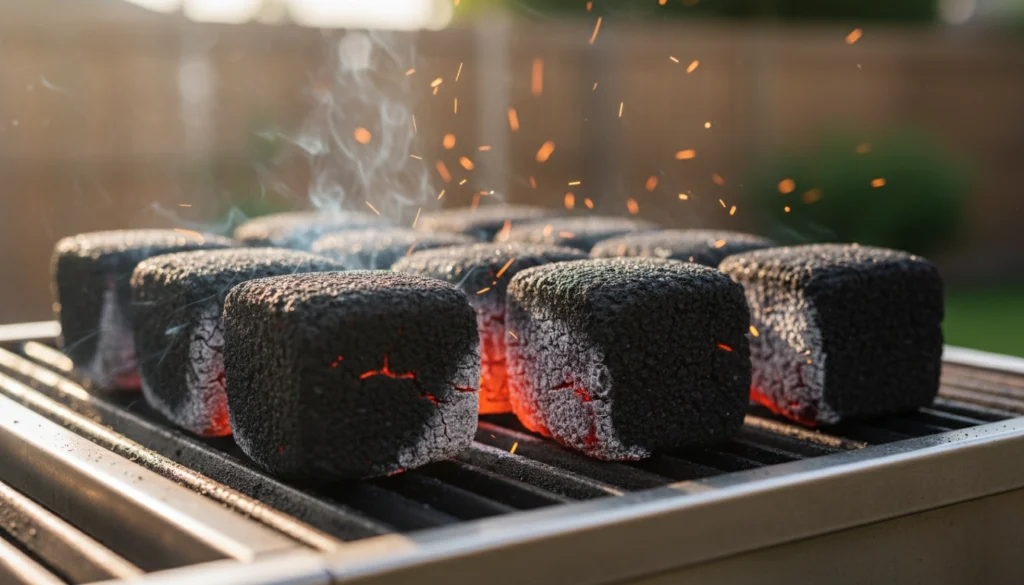
Close-up of glowing coconut shell charcoal briquettes burning evenly on a BBQ grill
Typical Acceptable Ranges for High-Grade Charcoal
Here’s a reference table many importers use when vetting charcoal shipments:
| Quality Metric | Target Range for High-Grade Charcoal |
|---|---|
| Moisture Content | ≤ 8% (ideally < 5–7%) |
| Ash Content | ≤ 2% (acceptable ≤ 3–5% for general use) |
| Fixed Carbon (FC) | ≥ 70–80% (depending on wood/shell type) |
| Volatile Matter | Low — detailed value depends on lab test |
| Bulk Density / Uniform Size | Uniform lumps or briquettes, minimal dust or fines |
| Odor / Smoke on Burn | Clean, minimal odor, minimal smoke |
How to Test Charcoal Quality Before Buying
Before placing a bulk order, conduct a simple charcoal audit test with these steps:
- Request a 2–5 kg sample per batch — enough to test quality under real conditions.
- Dry test — weigh sample, dry in an oven or sunlight, re-weigh to check moisture baseline.
- Ignition test — ignite charcoal; assess ignition time, flame intensity, smoke, odor, burn stability.
- Burn duration test — observe how long usable heat lasts, record time to ember fade.
- Ash residue analysis — burn to completion; measure ash weight and check ash color (light ash = better).
- Density/Structure test — inspect lumps: uniformity, hardness, no soft spots or mixed materials.
- Lab test (if possible) — send sample to lab for fixed carbon, volatile matter, ash content, calorific value.
Keep detailed records. Compare results against your quality benchmark table. Reject batches that fall short.
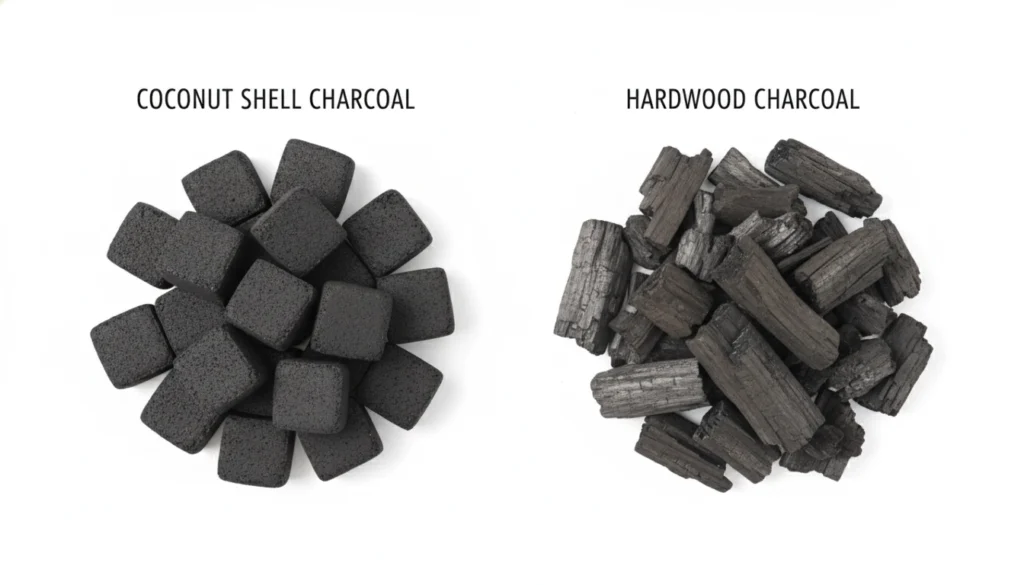
Side-by-side comparison of coconut shell charcoal briquettes and irregular hardwood charcoal pieces
Documentation & Certificates Importers Should Request
To ensure traceability and quality, ask suppliers for:
- Certificate of Analysis (CoA) — covering moisture, ash, fixed carbon, volatile matter, calorific value
- Batch number & production date — to track batch-to-batch consistency
- Raw material source documentation — species or type of wood/shell used, geographic origin
- Processing method disclosure — kiln or retort type, drying method, screening & sorting procedures
- Packaging & storage conditions — packaging type, moisture-proof, sealed/palletized
Refuse suppliers who cannot provide such documentation — transparency is a key indicator of quality and reliability.
Common Problems with Low-Quality Charcoal & Associated Risks
Importing or using subpar charcoal often leads to:
- Low heat output and poor performance
- Short, inconsistent burns increasing fuel consumption
- High ash residue causing waste, cleanup, and equipment issues
- Smoke or odor — problematic for food use, indoor heating, or shisha/briquette markets
- Inconsistency across batches — unpredictable supply risks
These issues can damage your business’s reputation or cause product losses.
Visual & Physical Inspection Checklist
When you receive charcoal — before acceptance or shipping — inspect:
- Color: deep black, no wood-grain, no green or bark remains
- Lump uniformity: consistent size, minimal dust or fines
- Density: heavy for size, no soft or hollow pieces
- Smell: neutral — no sour or chemical odor
- Ash after small burn: light grey or white, minimal residue
- Moisture: dry to touch, no dampness or clumping
Use this checklist for quick vetting before full acceptance.
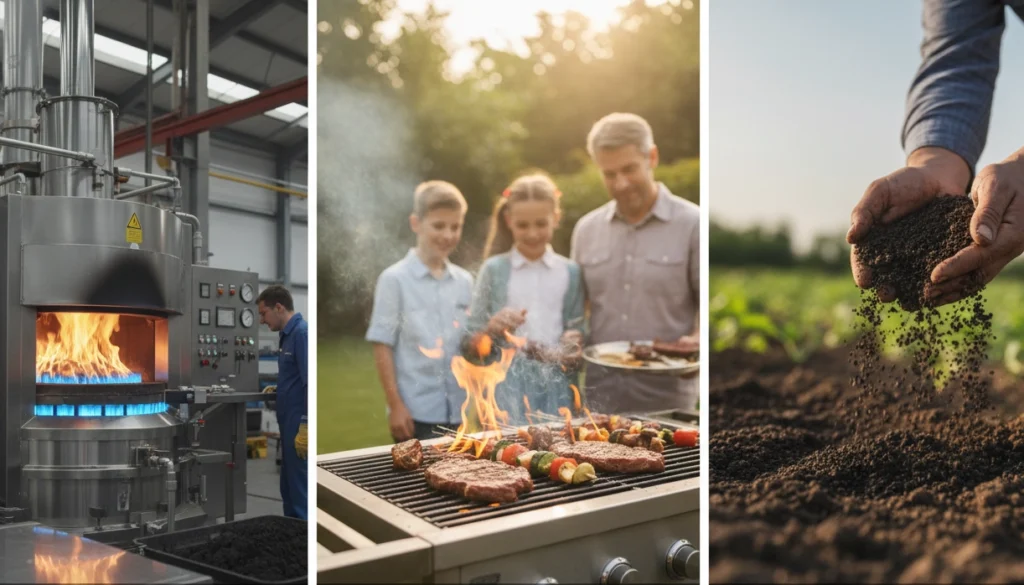
Charcoal used in industrial furnaces, backyard BBQ grilling, and agricultural soil enrichment
Buyer’s Decision Matrix: What Standards Fit Which Use
| Use Case | Critical Standards | Recommended Charcoal Type |
|---|---|---|
| Food grilling / BBQ / Restaurant | Low ash, clean burn, stable heat, low odor | Coconut shell charcoal with low ash or premium hardwood charcoal |
| Industrial fuel / kiln heating | High fixed carbon, high density, consistent burn | Dense hardwood charcoal |
| Briquette production / powder charcoal | Uniform size, minimal ash/fines | High-quality coconut shell charcoal |
| Shisha / clean-burn markets | Very low ash & volatile matter, odorless | Clean coconut shell charcoal with proper CoA |
| Export to regulated markets | Complete documentation, batch testing, low moisture | Certified batches (shell or hardwood) |
Use this matrix to guide procurement decisions based on end use.
FAQ
Q: What are the most important charcoal quality standards I should check before import?
A: Moisture content, ash content, fixed carbon (FC), volatile matter, and lump uniformity. These parameters determine heat output, burn duration, and cleanliness.
Q: What is acceptable ash content for premium charcoal?
A: Ideally ≤ 2%. Up to ~3–5% ash can be acceptable for general-purpose use but lower ash ensures better performance and less residue.
Q: Why is moisture content critical?
A: High moisture reduces combustion efficiency, causes smoke, delays ignition, and lowers calorific value — leading to poor performance.
Q: Can I rely on supplier specification without testing?
A: No — always request a sample, conduct your own burn or moisture test, and (if possible) lab analysis. Suppliers’ specs can vary or be inaccurate.
Q: Does coconut shell charcoal meet the same quality standards as hardwood charcoal?
A: Yes — if processed properly, coconut shell charcoal can match or exceed standards for moisture, ash, and fixed carbon. Proper sourcing and processing are key.
Q: What documentation should I demand from a charcoal supplier?
A: Certificate of Analysis (CoA), batch number, raw material origin, processing method, moisture and ash test results, packaging and storage records.
Understanding and enforcing charcoal quality standards is crucial for importers, suppliers, and businesses relying on charcoal. Moisture, ash, fixed carbon, density, and documentation define performance, reliability, and value.
Before committing to large orders, always request samples, test properly, and verify supplier transparency.
Ready to source premium charcoal with certified quality? Request a free quotation and sample today — and ensure you get charcoal that meets your standards.