If your business depends on high-quality charcoal—for shisha, metalworking, activated carbon, or food-service grilling—understanding coconut shell charcoal production helps you choose reliable suppliers and plan purchases. Coconut shell charcoal is prized for high fixed carbon, low ash, and strong calorific value, but the end quality depends directly on how shells are prepared, carbonized, and graded.
This guide gives a clear, visual, step-by-step breakdown of the production process used by commercial manufacturers: raw material selection, drying, carbonization (kiln options), cooling and sorting, post-processing (crushing, screening, briquetting), and basic quality tests. Along the way you’ll find practical yield figures, typical equipment choices, and key quality metrics buyers use when specifying orders.
Why coconut shell charcoal?
Coconut shell charcoal is a premium industrial and culinary fuel made by carbonizing mature coconut shells. It’s valued because it typically offers high fixed carbon, low ash, and consistent heat, making it suitable for applications from BBQ briquettes to activated carbon feedstock. For businesses, these characteristics translate into predictable performance and lower waste. Many producers now use improved kilns and controlled carbonization to maximize quality and reduce smoke.
Raw materials & quality criteria
Shell selection and contaminants
Start with mature, de-husked coconut shells. Avoid green shells or those contaminated with oil, salt, or wood ash. Contaminants cause uneven carbonization and raise ash content. Commercial suppliers sort shells and often wash them before drying.
Moisture content targets
Moisture should be reduced to <15% prior to carbonization for efficient heating and stable yields. Many operations sun-dry shells, while higher-throughput mills use mechanical dryers. Moisture directly influences carbonization time and final fixed carbon percentage.
Carbonization: methods & kilns—coconut shell charcoal production
The core transformation—converting organic shell to charcoal—is carbonization: heating in a low-oxygen environment so volatile compounds drive off and carbon remains. Different methods affect yield, quality, emissions, and throughput.
Traditional pit & brick kilns
- What they are: Simple pits or brick-lined chambers where shells are stacked and partially burned with limited air.
- Pros: Low capital cost, simple to operate.
- Cons: Poor control over temperature and oxygen, higher ash, more smoke and emissions.
- Use case: Small rural operations or artisanal producers.
Traditional methods are still common where capital is constrained, but they produce variable quality.
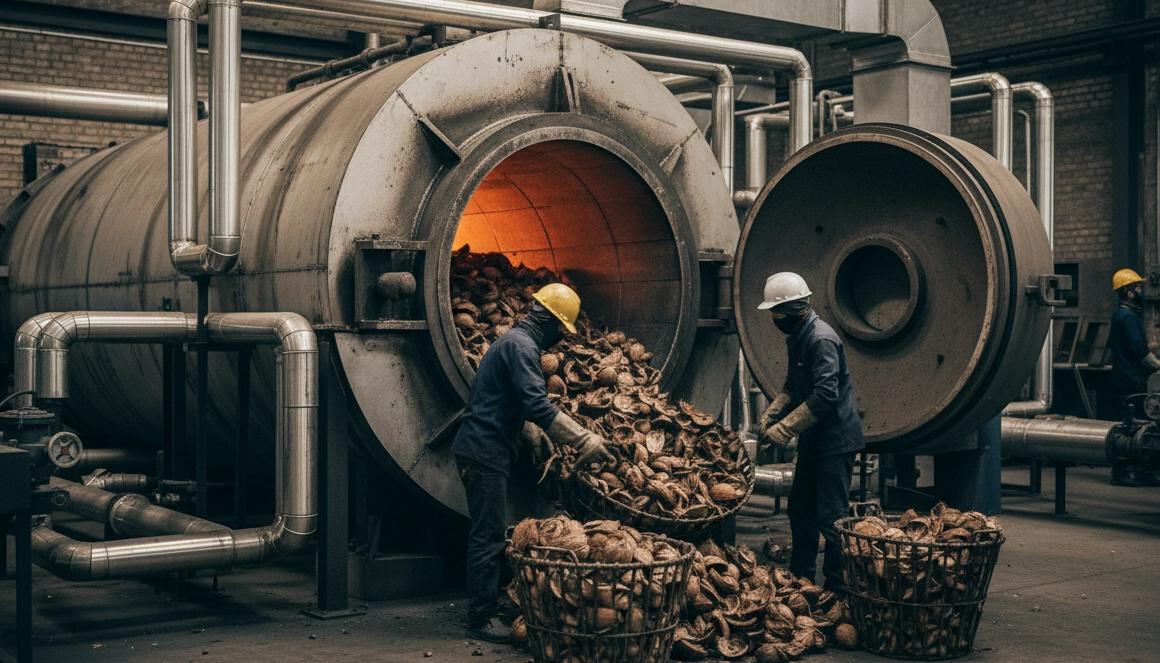
Loading a retort (smokeless kiln) for controlled carbonization
Retort & smokeless kilns
- What they are: Sealed chambers (retorts) where material is heated indirectly; produced gases are captured and sometimes combusted to fuel the kiln.
- Pros: Higher yields, lower smoke, better temperature control. Fuel gas can be reused to improve energy efficiency.
- Cons: Higher capital cost and more technical operation. Smokeless or retort kilns are preferred for mid-sized commercial production because they improve yield and reduce pollution.
Experimental designs show improved yields (up to ~48% under test conditions).
Continuous industrial carbonizers
- What they are: Mechanized systems for constant feed and discharge—best for high-capacity factories.
- Pros: High throughput, stable product quality, lower labor intensity.
- Cons: Significant up-front investment and maintenance.
Large exporters and activated carbon feedstock producers typically use continuous systems paired with downstream grinding and activation lines. Equipment vendors detail models for varying scales.
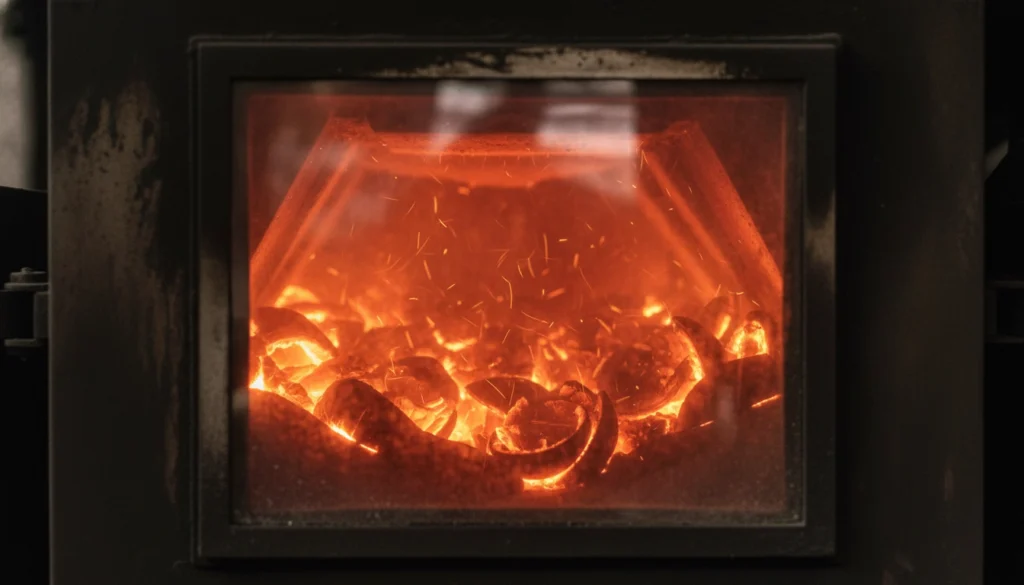
Inside view of a kilning operation (infrared/tinted view to indicate heat)
Cooling, quenching & safety
After carbonization, controlled cooling prevents spontaneous reignition. Cooling is typically done inside the sealed retort or by closing vents and allowing the charcoal to cool under limited oxygen. Quenching with water is used in some traditional methods, but it can introduce moisture and degrade quality if not done carefully.
Safety note: Carbonization generates combustible gases (CO, H₂, methane). Proper venting and gas handling are essential. Retorts that capture and burn off gases improve both safety and energy efficiency.
Post-processing: crushing, screening & grading
Once cooled, charcoal is sorted by size, screened for ash and uncarbonized pieces, and sometimes crushed or milled for briquettes or activated carbon feedstock.
Typical post-processing steps:
- Primary screening — remove oversize/uncharred pieces.
- Crushing / milling — produce powder for briquettes or activation.
- Magnetic separation — remove metallic contaminants from processing equipment.
- Packaging & grading — commercial grades (e.g., 3–8 mm lumps, powdered) with moisture, ash, and fixed carbon specs.
Making briquettes & activated carbon feedstock
Briquettes
For briquettes, crushed charcoal is mixed with a binder (cassava starch, molasses, or other food-safe binders), pressed into molds, and dried. Drying must reach low moisture to ensure durability and burn consistency. Home or small-scale guides illustrate simple molding steps; industrial lines use hydraulic presses and controlled ovens.
Activated carbon feedstock
To make activated carbon, high-quality coconut shell charcoal (low ash, high fixed carbon) is further processed and activated—commonly with steam or chemical activation—to develop a porous surface area. This requires dedicated activation furnaces and quality control. Producers of activated carbon select shells and carbonization conditions to maximize precursor properties.
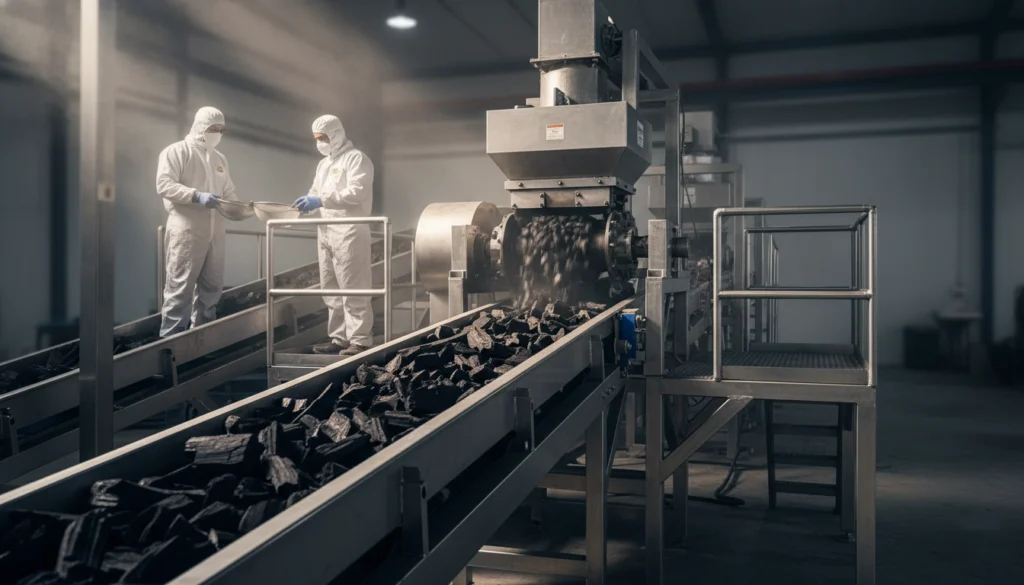
Crushing and screening line producing graded charcoal sizes for briquettes
Quality metrics, yields & typical specs
Understanding specs helps you set purchase requirements.
Common commercial specs (typical ranges):
- Fixed carbon: 70–85%
- Ash content: 2–7% (lower is better)
- Moisture: ≤ 15% at sale (often ≤10% for premium charcoal)
- Calorific value: ~6,000–7,100 kcal/kg for premium grades
Yields: depending on kiln type and operating mass, charcoal yield from coconut shell can range from ~30% (primitive pits) to ~45–48% for optimized retorts and smokeless kilns in lab/field tests. One experimental study found yields up to 48% under optimal mass and kiln conditions.
Environmental, health & regulatory notes
- Emissions: Traditional carbonization produces heavy smoke and VOCs; smokeless retorts and gas recapture reduce emissions significantly.
- Waste: Ash is minimal compared to wood charcoal but should be managed responsibly.
- Worker safety: Ensure protective equipment for dust (when crushing powder) and gas monitoring near kilns.
- Regulation: Local air quality and waste rules may apply; exporters must meet phytosanitary and shipping regulations.
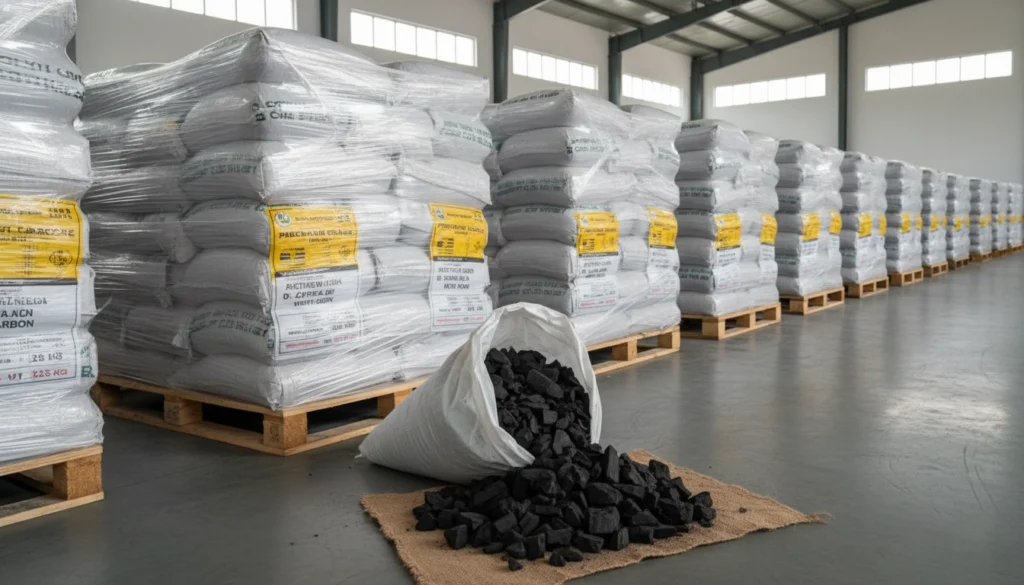
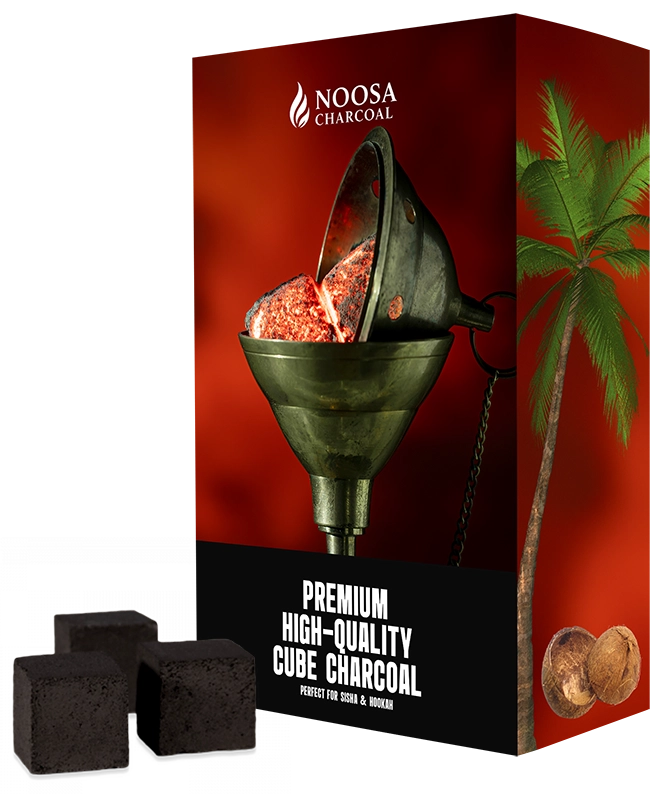
05 packaged charcoal ready copy
Buying guide for businesses
When sourcing coconut shell charcoal for a business, request:
- Certificate of analysis (moisture, ash, fixed carbon).
- Photos of the kiln & production area (to verify hygienic handling).
- Sample (1–5 kg) before placing large orders.
- Production capacity & lead times (tons/month).
- Packaging & customs documents for export.
Ask suppliers to share which carbonization method they use — retort/smokeless kilns typically indicate better quality control and lower emissions.