If your business depends on charcoal — for grilling, metalwork, heating, or retail supply — a proper hardwood charcoal heat test can mean the difference between premium fuel and disappointing stock. Not all hardwood charcoal is equal. Variations in wood species, carbonization process, moisture content, and density can drastically change burn temperature, burn duration, ash residue, and overall performance.
In this guide, we’ll show you exactly how to test hardwood charcoal before buying or importing — and how to spot which charcoals burn the hottest and longest. You’ll get insight into what makes certain charcoal perform better, how to compare different types (oak, hickory, mesquite, maple, etc.), and what to check before placing bulk orders. Whether you’re a supplier, restaurateur, or industrial buyer, this article gives you the knowledge to ensure you get the right charcoal quality for your needs.
Why Heat & Burn Performance Matter for Hardwood Charcoal
Hardwood charcoal is often valued for its capacity to produce high, consistent heat and long-burning coals. For businesses — from BBQ restaurants to metal forges, from stove heating to commercial roasting — the right charcoal can influence:
- Cooking or heating efficiency
- Fuel costs and burn duration
- Product consistency (e.g., grilled food quality, consistent temperature)
- Customer satisfaction and brand reputation
Choosing charcoal blindly — without knowing its performance — can result in underwhelming heat, short burn time, excessive ash, or wasted fuel. That’s why a proper hardwood charcoal heat test before bulk buying is essential.
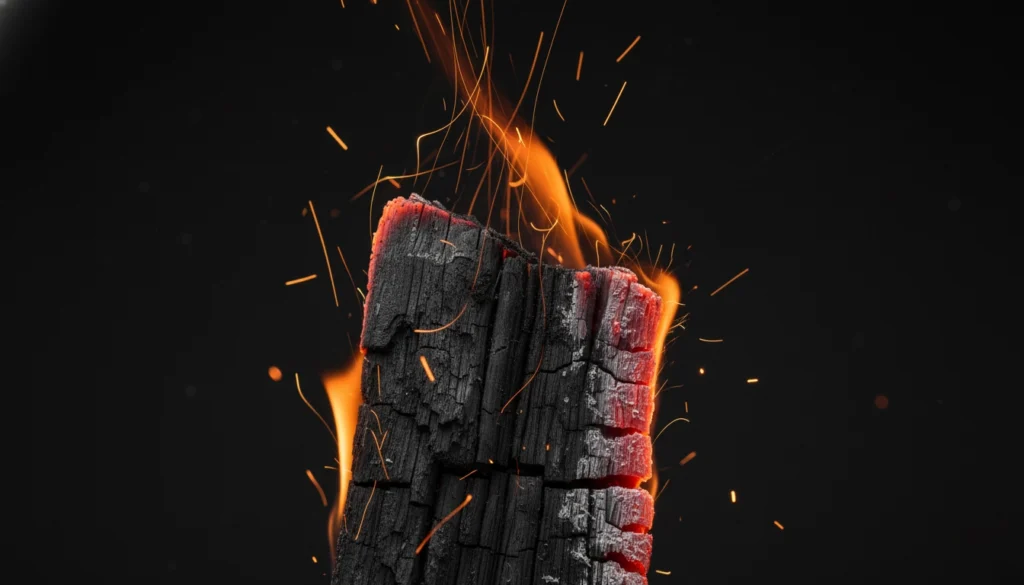
The ignition phase provides the first indicator of heat potential and charcoal density.
Key Factors That Determine Charcoal Heat & Burn Duration
Wood species & density
Not all hardwoods burn the same. Woods like oak and hickory are dense, which generally results in charcoal with more carbon per volume. Dense wood → denser charcoal → more stored energy → longer, hotter burn.
Less-dense hardwood or mixed wood can yield charcoal that burns quickly but dies down fast. If you’re sourcing hardwood charcoal, ask for the wood species used in production.
Carbonization & fixed carbon content
How charcoal is made matters. Proper carbonization — with enough heat and controlled oxygen — removes volatile compounds, leaving high fixed carbon. High fixed carbon equates to hotter, longer burns.
Poor carbonization (too quick, uneven, or low temperature) leads to low fixed carbon, higher volatile matter, and unpredictable combustion. Always prefer charcoal with documented carbonization quality.
Moisture, impurities & processing quality
Moisture is a charcoal killer. Wet charcoal ignites poorly, burns unevenly, and yields poor heat. Impurities — bark, soft wood inclusions, mixed materials — lead to soot, smoke, and weak burn.
Quality processing (clean wood, proper drying, good kiln or retort carbonization) produces charcoal that ignites easily, burns cleanly, and retains heat well.
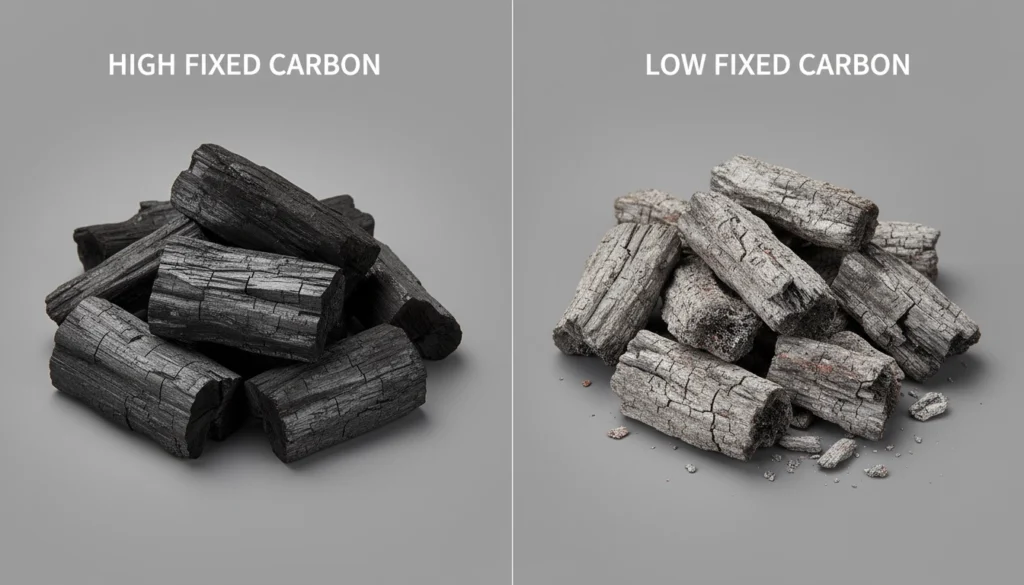
High fixed-carbon charcoal burns hotter, longer, and with less ash
Common Hardwood Charcoals Compared: Performance Overview
Here we review popular hardwood charcoals many businesses source. Performance varies depending on original wood and processing quality.
Oak-based charcoal
- Well-known for stable burns and good heat.
- Produces consistent coals with moderate ash and long burn time — ideal for grilling, roasting, and heating.
- Because oak is dense, when properly processed, oak charcoal generates good thermal output and predictable performance.
Hickory-based charcoal
- One of the densest hardwoods used for charcoal.
- Provides very high heat output and long burn duration.
- Favoured by BBQ restaurants and food-service businesses for intense searing heat or long grilling sessions.
Mesquite-based charcoal
- Lighter than oak or hickory, but ignites quickly and burns very hot initially.
- Burn duration tends to be shorter than oak or hickory, but ideal when short, high-heat bursts are needed (e.g. searing steak, quick grilling, rapid heat applications).
Maple/Fruitwood-based charcoal
- Offers a balanced profile: clean burn, moderate-high heat, decent burn time.
- Often used when flavor matters (some fruitwoods add subtle aroma) or when consistency and clean combustion is required.
Mixed Hardwood & Unspecified Hardwood Charcoal — Risks & Variability
Many mass-produced charcoals mix various hardwood scraps, softwood residues, or unidentified wood — leading to unpredictable burn behavior. This often saves cost but compromises quality: inconsistent heat, variable ash, shorter burn, possible smoke or odor.
For businesses, these mixed charcoals can lead to unpredictable performance, affecting cooking quality, energy efficiency, or customer satisfaction.
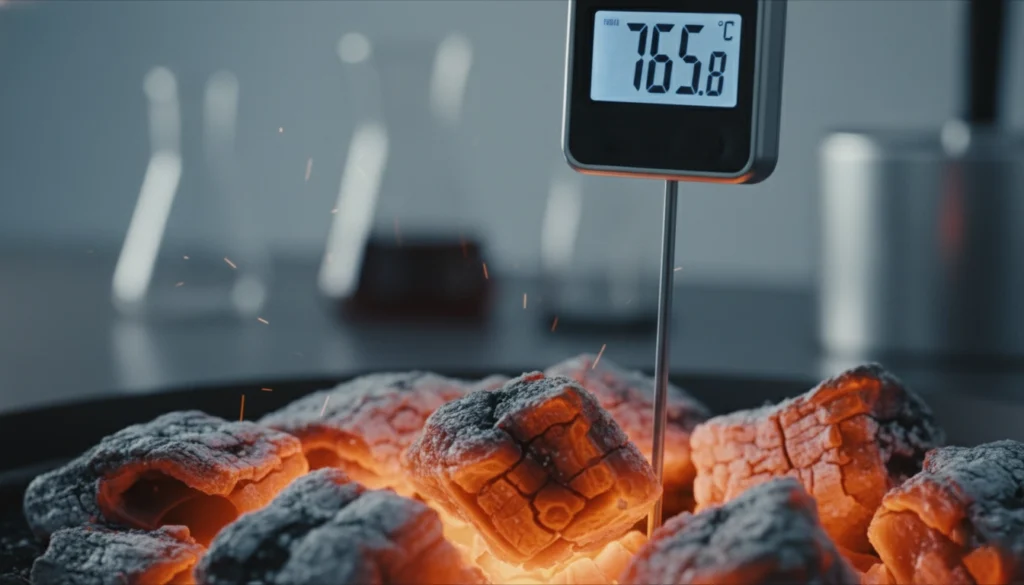
A proper hardwood charcoal heat test uses precise temperature measurement tools, not guesswork.
Heat & Burn Performance Table
| Charcoal Type / Wood Source | Heat Output / Intensity | Burn Duration (approx) | Best Used For |
|---|---|---|---|
| Hickory hardwood charcoal | High | Long | BBQ restaurants, roasting, intense heat use |
| Oak hardwood charcoal | Medium-High | Longest | Grilling, heating, general-purpose fuel |
| Mesquite hardwood charcoal | Very High (initial) | Medium | Quick searing, short-time grilling or heating |
| Maple / Fruitwood charcoal | Medium | Medium-Long | Clean burn cooking, ovens, balanced use |
| Mixed / unspecified charcoal | Variable / Low–Medium | Short to medium | Budget fuel only; not recommended for premium work |
Note: Actual performance depends heavily on charcoal manufacturing quality — moisture, density, carbonization. Always test small sample before bulk order.
How to Conduct Your Own Hardwood Charcoal Heat Test
Before committing to a large purchase, you can run a simple in-house test. Here’s how:
- Select small samples — ~2–3 kg from each charcoal source or type you consider.
- Weigh and inspect visually — note density, hardness, appearance (uniform black, no debris or bark).
- Ignite under controlled conditions — use same ignition method (e.g. lighter or starter) for each sample.
- Measure burn behavior — record ignition time, time to full ember/coal, flame intensity.
- Observe burn duration — note how long usable coals remain and when temperature drops.
- Check ash residue — lighter ash indicates better carbonization and cleaner burn. Dark or heavy ash suggests impurities or incomplete burn.
- Smell & smoke test — smoke or unpleasant odor signals poor quality or residual volatile matter or impurities.
Record all observations in a table. This gives real-world data about heat, burn time, and quality before investing in bulk charcoal.
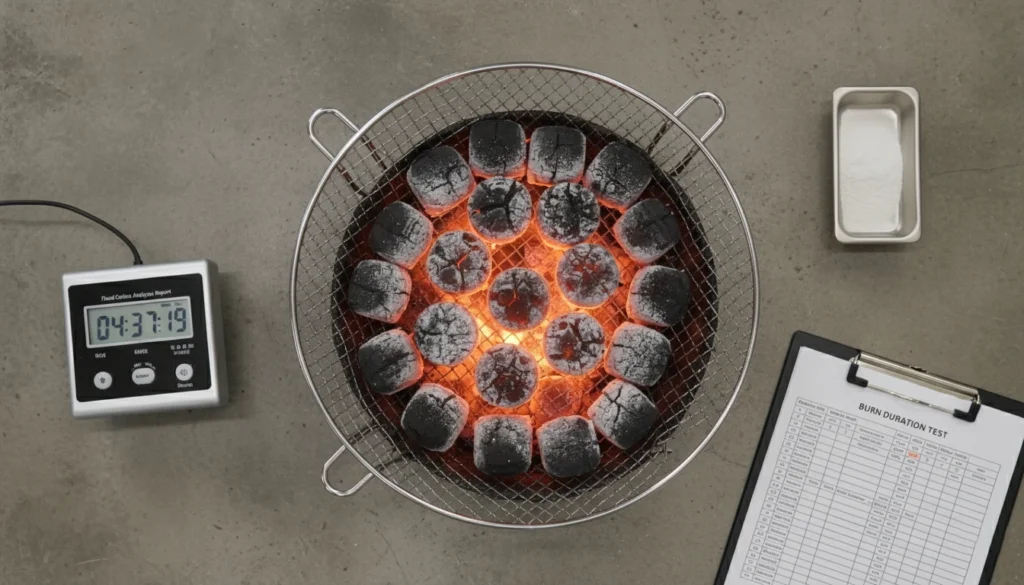
Burn duration is one of the most important signs of high-quality hardwood charcoal
What to Inspect When Buying Charcoal — Quality Checklist
When evaluating a supplier or batch for purchase, check:
- Wood source and species (e.g. oak, hickory, mesquite, fruitwood)
- Charcoal processing method — kiln or retort carbonization, drying quality, density
- Appearance: uniform black color, no bark or softwood mixed, no debris
- Sample burn test results (heat, burn time, ash)
- Packaging and storage: dry, sealed, moisture-free, well-labeled
- Consistency across batches — avoid mixed or random wood types
For buyers supplying to clients or restaurants, always request a sample and test data before placing large orders.
Pitfalls of Poor or Mixed Hardwood Charcoal — What Goes Wrong
Using low-quality or mixed hardwood charcoal often leads to:
- Weak or inconsistent heat — poor cooking or heating performance
- Short burn time — frequent refueling or interrupted processes
- High ash residue — more cleanup, waste, potential equipment issues
- Smoke, odd odor, or soot — bad for food prep, indoor use, or sensitive processes
- Unreliable batch-to-batch performance — damaging business reputation
For businesses, these risks translate to higher costs, dissatisfaction, and operational inefficiency.