If you’re sourcing fuel or charcoal for grilling, industrial use, or export — you need a reliable, transparent hardwood charcoal production process. Not all charcoal is made equal: quality depends heavily on how timber is selected, carbonized, dried, processed, and packaged.
This guide walks you through every stage of charcoal production — from logging and wood selection to kiln/retort carbonization, cooling, crushing or grading, and final packaging — culminating in export-ready product. Along the way you’ll learn which steps influence heat output, ash level, fixed carbon content, and consistency. By understanding the full process, your business can demand higher standards, avoid subpar batches, and negotiate better deals.
Whether you’re a wholesaler, retailer, or direct user — this post offers a comprehensive, step-by-step reference to ensure you import or use hardwood charcoal you can trust.
Why Understanding the Hardwood Charcoal Production Process Matters
Hardwood charcoal is more than “burned wood.” Its quality depends on each step — from timber sourcing to final packaging.
For businesses relying on charcoal — whether for grilling, manufacturing, or resale — knowing the full process helps you:
- Evaluate supplier quality objectively.
- Avoid charcoal with low fixed carbon or high ash.
- Ensure consistent heat output and performance.
- Minimize risks of poor burns, smoke, or inconsistent batches.
Understanding the process gives you power — to demand transparency, test properly, and secure charcoal that meets your standards.
Stage 1: Timber Selection & Harvesting
Wood species and density criteria
Not all hardwoods are equal. Good charcoal starts with dense, slow-growing hardwood species (e.g. oak, acacia, beech, etc.). Density ensures more fixed carbon after carbonization, yielding hotter, longer-burning charcoal.
Logging best practices and sustainability
Responsible producers follow sustainable logging: harvesting mature trees, avoiding mixed softwood, ensuring minimal wood damage, and complying with local forestry regulations. This helps maintain wood quality and ensures eco-friendly sourcing.
Stage 2: Wood Preparation
Cutting, splitting, and sizing
After felling, logs are cut and often split into smaller pieces. Uniform size ensures even carbonization. Irregular or mixed-size pieces burn unevenly, leading to under- or over-carbonized charcoal.
Seasoning and drying logs
Fresh wood must be dried (seasoned) to reduce moisture. High moisture causes inefficient carbonization, smoke, and low fixed carbon yield. Ideally, wood should be air-dried or kiln-dried before carbonization.
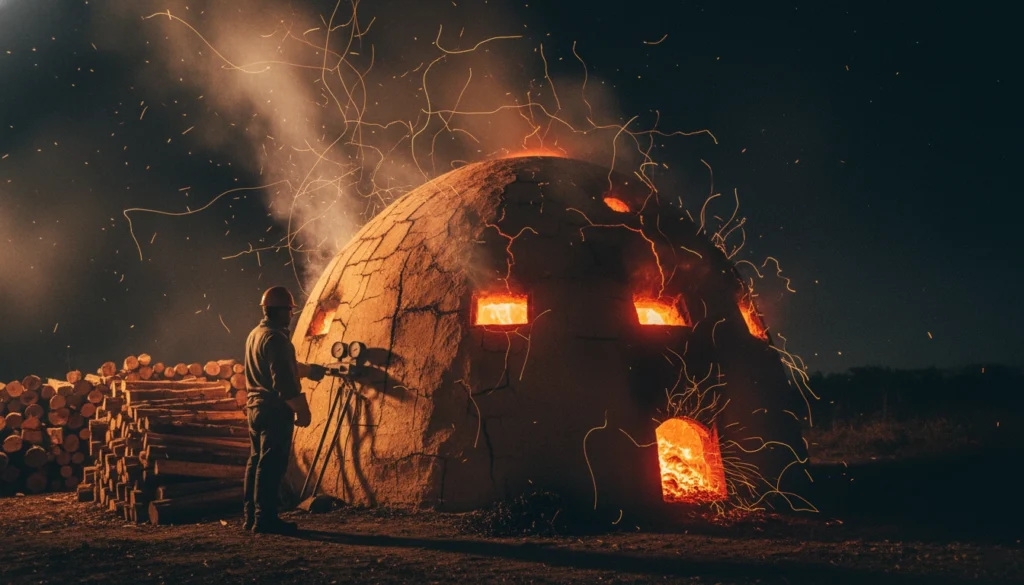
Traditional dome kiln heating hardwood to convert it into charcoal
Stage 3: Carbonization — Kilns, Retorts & Methods
The core of the hardwood charcoal production process is carbonization — transforming wood into charcoal by burning in low-oxygen conditions.
Traditional pit/earth kilns
- Method: Wood is stacked in a pit, covered, and slowly ignited.
- Pros: Low-cost, minimal infrastructure.
- Cons: Poor control over oxygen & temperature → variable quality, high ash, uneven carbonization.
Metal retorts & smokeless kilns
- Method: Sealed metal chambers heat wood indirectly. Gases are vented or burned off.
- Pros: Better temperature control, higher yield, cleaner charcoal, lower smoke.
- Cons: Requires investment and technical know-how.
Continuous industrial carbonizers
- Method: Mechanized feeding and discharge, steady carbonization cycles.
- Pros: High throughput, consistent quality — ideal for exporters and large-scale production.
- Cons: High initial investment, maintenance.
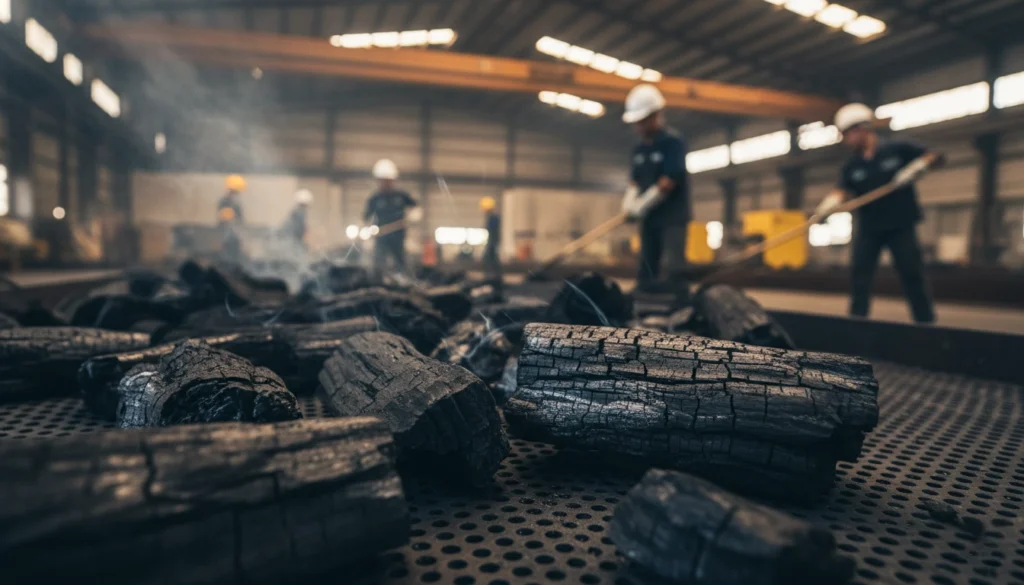
Freshly carbonized hardwood charcoal cooling before sorting
Stage 4: Cooling, Quenching & Initial Quality Check
After carbonization, charcoal must cool under limited oxygen to avoid spontaneous ignition. Some producers quench with water (though this may cause moisture issues), others use controlled cooling inside retorts.
Initial quality checks include visual inspection, smell, and checking for soot or uncarbonized wood. Good producers tag batches or record kiln data.
Stage 5: Post-Processing — Crushing, Screening, Grading
Depending on end use (lump charcoal, briquettes, activated carbon), charcoal is processed:
- Screening & grading: Separates lumps, fragments, dust. Ensures uniform size and quality.
- Crushing & milling: For briquettes or powdered products.
- Cleaning: Removing ash dust, sand, foreign materials to ensure purity.
This step greatly affects consistency, ash content, and performance.
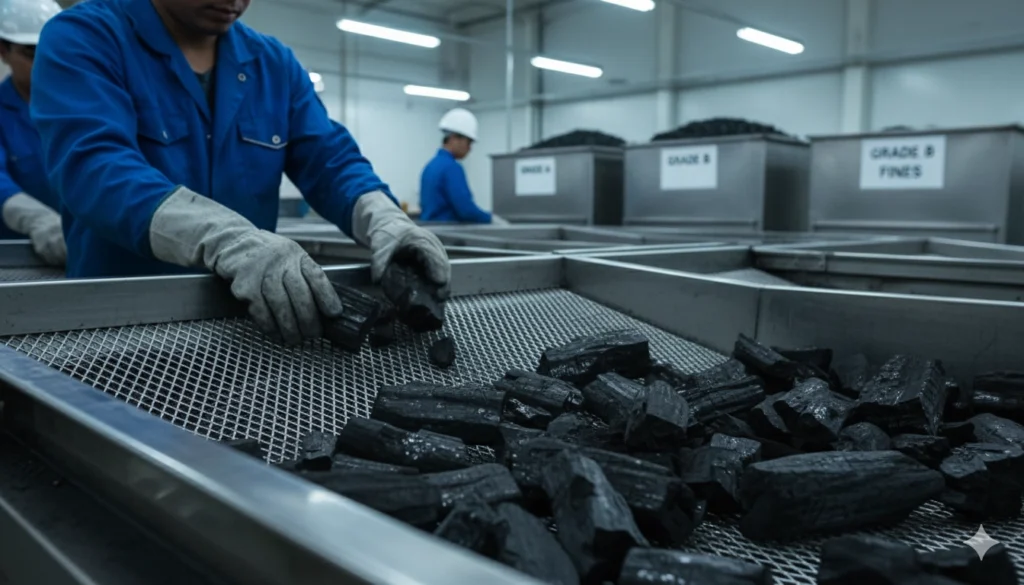
Quality control team screening, grading, and removing impurities from finished hardwood charcoal
Stage 6: Quality Assurance & Testing
Reliable producers test batches: fixed carbon percentage, moisture content, ash content, volatile matter, and calorific value.
Quality assurance helps:
- Maintain consistent heat output
- Minimize ash and smoke
- Ensure safety & export compliance
Buyers should ask for Certificates of Analysis (CoA) and request sample tests before bulk orders.
Stage 7: Packaging, Storage & Export Preparation
Export-ready hardwood charcoal must be:
- Properly bagged or palletized (moisture-proof)
- Labeled with batch, spec, weight, origin
- Stored in a dry, ventilated warehouse to avoid moisture pickup
- Optionally certified for export compliance
Proper packaging ensures durability, consistency, and safe transport.
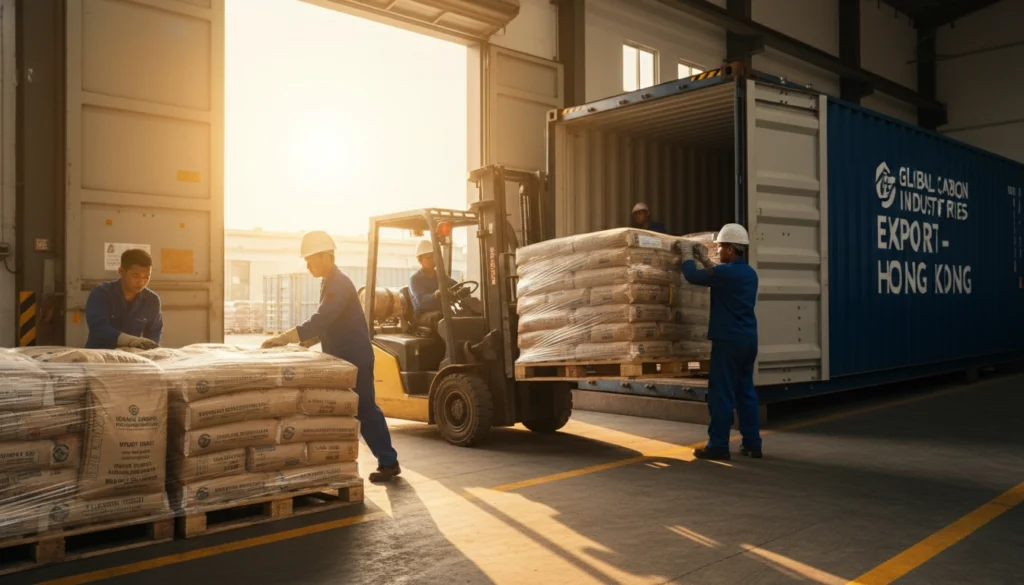
Export-ready hardwood charcoal bags being palletized and loaded into containers
Common Pitfalls & How to Avoid Low-Quality Charcoal
Beware of:
- Mixed wood species or softwoods → inconsistent burn quality
- Inadequate drying → high moisture, poor carbonization
- Cheap pit kilns → high ash, uneven quality
- Poor post-processing → dust, fragments, inconsistent size
- Weak packaging → moisture absorption, mold, reduced quality
To avoid, always request documentation, samples, kiln data, and inspect first.
FAQ — Common Questions About Hardwood Charcoal Production
Q: What wood species make the best hardwood charcoal?
A: Dense, slow-growing hardwoods such as oak, acacia, beech, or similar species generally produce charcoal with high fixed carbon, consistent heat, and long burn — ideal for grilling or export.
Q: Why does the type of kiln matter?
A: Kiln type affects carbonization quality. Retorts or industrial carbonizers yield cleaner, higher-quality charcoal than simple pit kilns — less ash, better carbonization, higher yield.
Q: How can I ensure charcoal is fully carbonized before buying?
A: Request a sample, check appearance (hard, black lumps), smell (should be neutral, not smoky), and if possible, inspect a lab test or certificate for fixed carbon, moisture, and ash content.
Q: What are risks of poor storage before export?
A: Moisture absorption, mold growth, loss of burn quality, inconsistent batches, and customer dissatisfaction.
Q: Can mixed hardwood batches be reliable?
A: Mixed hardwood can work if uniform in density and properly processed — but mixing softwoods or inconsistent species often reduces overall quality and performance.
Q: How important is post-processing (screening & grading)?
A: It’s critical. Uniform size and purity affect burn consistency, ash content, and user satisfaction — especially for retail, grilling, or industrial uses.
A robust hardwood charcoal production process — from careful timber selection, precise carbonization, quality testing, to proper packaging — is the backbone of reliable, high-performance charcoal. Whether you run a grill business, export charcoal, or supply fuel to factories, knowing every step helps you secure quality and avoid risk.
Ready to source premium hardwood charcoal? Request a free quotation and sample today. Test quality yourself before placing bulk orders — your business depends on it.