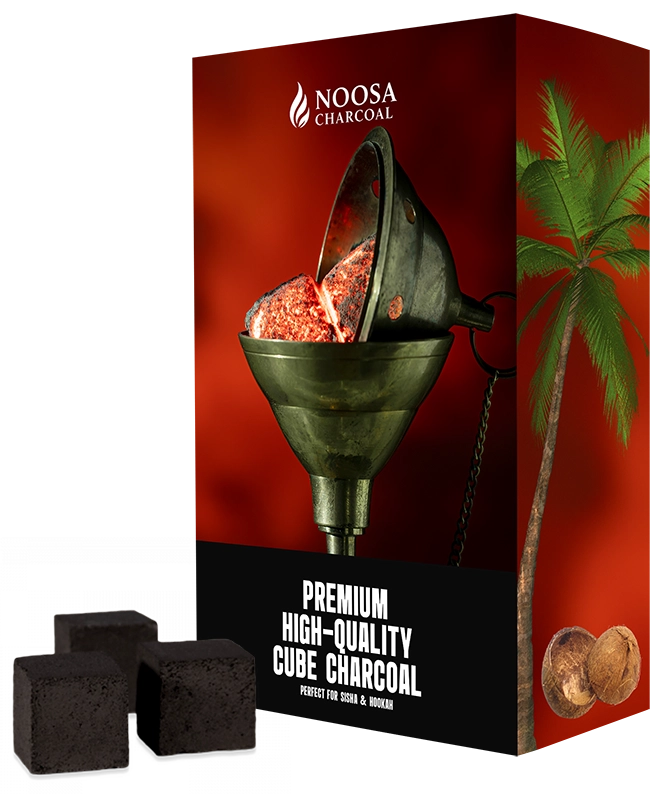
Whether you import coconut shell charcoal for grilling, shisha, industrial fuel or activated carbon production — selecting high-quality material is crucial. Poor-quality charcoal can lead to weak heat, excessive ash, unpleasant odor, irregular burn, or even shipment rejection.
This guide helps you identify high-quality coconut shell charcoal before buying. We’ll cover the technical specs you should check (fixed carbon, ash, moisture, volatile matter), physical and sensory cues (shape consistency, ash color, smell), documentation to request (lab reports, certificates), and practical quality-check methods. Use this as your buyer checklist before placing bulk orders or committing to a supplier.
At the end you’ll also find a set of ready-to-use image prompts for product pages and a FAQ addressing common doubts.
Why Quality Testing Matters
Buying charcoal without verifying quality is risky. Low-grade coconut shell charcoal often comes from mixed raw material (wood, soft shells, fillers), poor carbonization, or careless handling. That results in:
- Low fixed carbon → weak heat & short burning time
- High ash → more residue, messy operation, potential equipment issues
- High moisture → difficulty igniting, unstable burn, mold risk in storage
- Impurities or foreign matter → contamination, odor, inconsistent combustion
For businesses — whether shisha lounges, BBQ restaurants, briquette producers, or industrial clients — consistent charcoal quality means fewer customer complaints, better performance, and predictable costs.
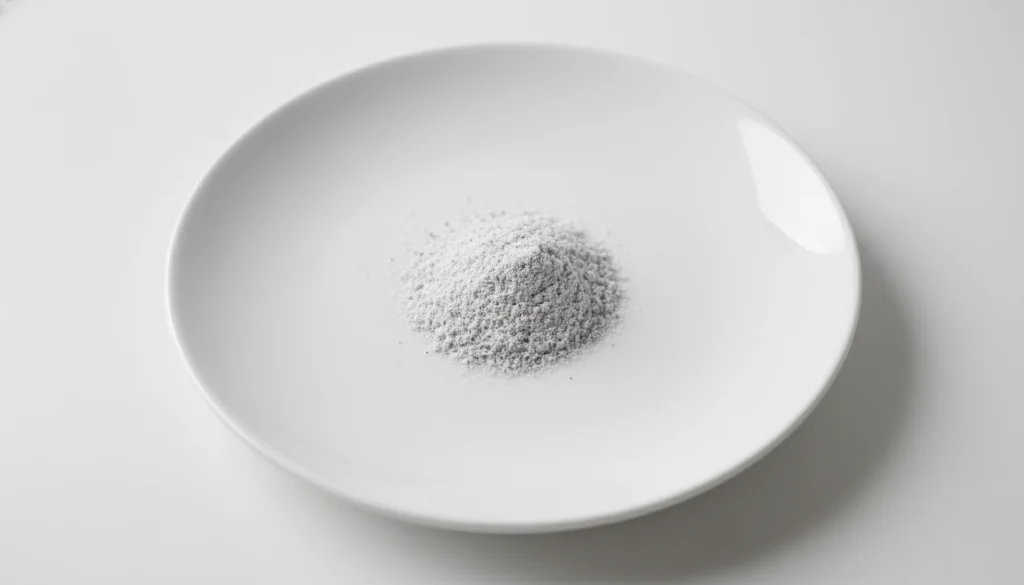
Charcoal burning test — glowing ember, stable heat output.
Key Specification Parameters to Check
Before buying, insist on a detailed specification sheet or Certificate of Analysis (CoA). Key parameters to verify:
Fixed Carbon Content
Fixed carbon is the combustible carbon content after volatile compounds are removed during carbonization. High fixed carbon means more efficient, hotter, and longer-lasting fuel.
- Recommended minimum: 75% (many premium producers aim for 80% or higher)
- Lower fixed carbon –> charcoal burns weakly and produces more smoke / residue.
Ash Content
Ash is the non-combustible residue after burning. Low ash ensures cleaner combustion, better airflow (for shisha), and less waste.
- Ideal ash content: ≤ 2% (some accept up to 2.5–3% for lower-grade charcoal)
- Ash above 3–5% often indicates impurities, poor raw material or incomplete carbonization.
Moisture Content
Moisture compromises ignition, heat, and storage stability.
- Recommended moisture: ≤ 6–8% (many buyers prefer <6%)
- High moisture → slow ignition, sputtering, potential mold, shipment issues.
Volatile Matter & Foreign Matter
Volatile matter refers to gases and compounds released when charcoal is heated before reaching stable carbon burn. Lower volatile matter ensures smokeless, odorless combustion — vital for shisha and food-grade uses. Foreign matter (wood fragments, sand, metal) affects safety and burn behavior.
- Volatile matter standard: typically ≤ 15%
- Foreign matter (impurities): Minimal — many quality standards specify ≤ 0.5%
Appearance, Color & Density
According to standards from Asian and Pacific Coconut Community (APCC), good coconut shell charcoal should be uniformly black, non-lustrous, with broken edges showing a shiny surface and a “conchoidal” fracture. When dropped on hard ground, pieces should give a clear ring.
Uniform size/distribution, consistent shape (for briquettes or cubes), and high density also indicate careful production and sorting.
Typical Specification Benchmarks (for reference)
Here is a quick reference table commonly used by reputable charcoal producers and exporters:
| Parameter | Premium Quality Target |
|---|---|
| Fixed carbon | ≥ 75–80% |
| Ash content | ≤ 2.0% (≤ 2.5–3.0% acceptable at lower grade) |
| Moisture content | ≤ 6–8% (ideally <6%) |
| Volatile matter | ≤ 15% |
| Foreign matter / impurities | ≤ 0.5% |
| Appearance | Uniform black color, no dust, no mixed-material residues |
If a batch meets — or exceeds — these benchmarks, it qualifies as high-quality coconut shell charcoal.
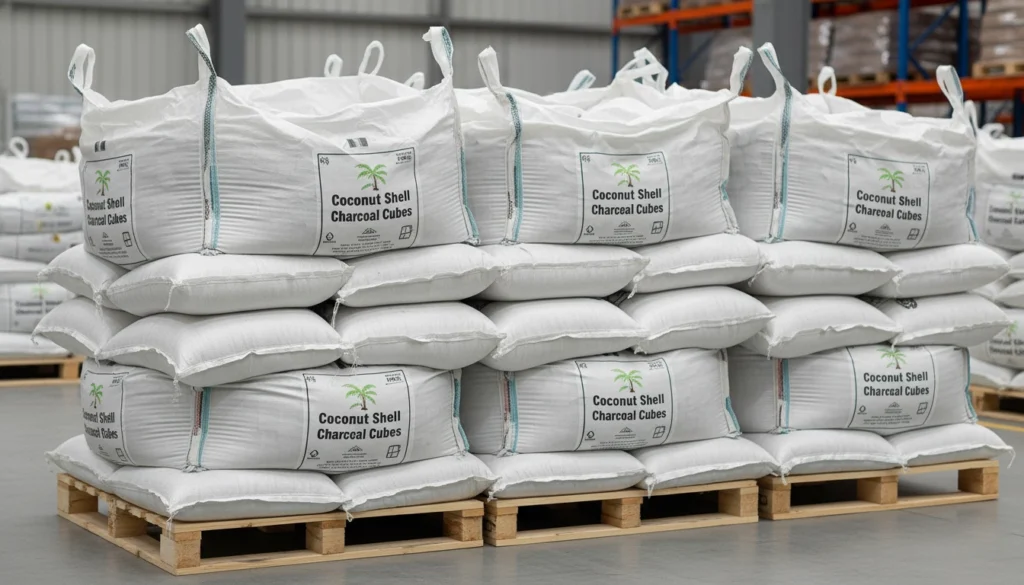
Uniform coconut charcoal cubes packed in sealed export-ready bags.
Physical & Sensory Quality Checks (Without Lab)
Even before lab tests, you can perform basic simple checks when you receive sample bags. These cues help catch obvious low-quality charcoal.
1. Shape, Uniformity & Density
- Pieces or briquettes should have consistent shape and size — no odd fragments, no mixed shapes.
- Density should feel solid and heavy for its size.
- Give two pieces a light knock — premium charcoal produces a clean, metallic “clack”; poor-quality pieces may sound hollow or crumble.
2. Surface & Fracture Appearance
- Color should be uniform black or dark grey, with a matte or slightly satin finish. Shiny gloss or lighter wood-grain patterns may indicate underprocessed or mixed-material charcoal.
- If you break a piece, the fracture should show a clean, conchoidal (shell-like) break — not fibrous, layered, or crumbly.
3. Burn & Ash Test
Light a small sample:
- Good charcoal should ignite within a few minutes, not after long delays.
- Burn should be steady, without loud cracking or popping.
- Ash residue should be light grey or white, fine and minimal. Heavy dark ash or large residue suggests impurities.
- Smoke or chemical smell — automatic red flag. Natural coconut charcoal burns nearly odorless if properly made.
4. Moisture/Storage Check
If charcoal feels damp, clumps, or if packaging shows condensation — that hints at poor drying or moisture absorption. Moist charcoal is harder to light, has uneven burn, and degrades faster.
5. Documentation & Lab Reports
Even good-looking charcoal could have hidden defects. Ask your supplier for:
- Certificate of Analysis (CoA) or lab test results listing fixed carbon, ash, moisture, volatile matter.
- Batch number, production date, and origin of raw material (100% coconut shell).
- Packaging and storage details — sealed, moisture-proof packaging is ideal.
When a supplier cannot or will not provide documentation — treat that as a red flag.
Differences Between Uses: What “High Quality” Means Depending on Your Needs
“High quality” may vary depending on how you plan to use the charcoal: grilling, shisha, briquette production, or industrial fuel. Here’s how to interpret specs per use case:
- BBQ/Grilling (Food Industry): Heat output and burn duration matter. Acceptable ash up to ~3%, moisture <8%. Density and shape must allow airflow and consistent burn.
- Shisha/Hookah: Requires very low ash (<2%), low volatile matter, odorless burn, dense cubes, stable heat for 60–90 mins. Any impurity or smoky odor ruins user experience.
- Briquette Production/Industrial Use/Activated Carbon Feedstock: Requires high fixed carbon, low ash, low volatile matter, plus uniform particle size or lump structure. Moisture and density are critical for downstream processing.
Therefore, when you define your “ideal charcoal,” match the spec targets to intended use before you buy.
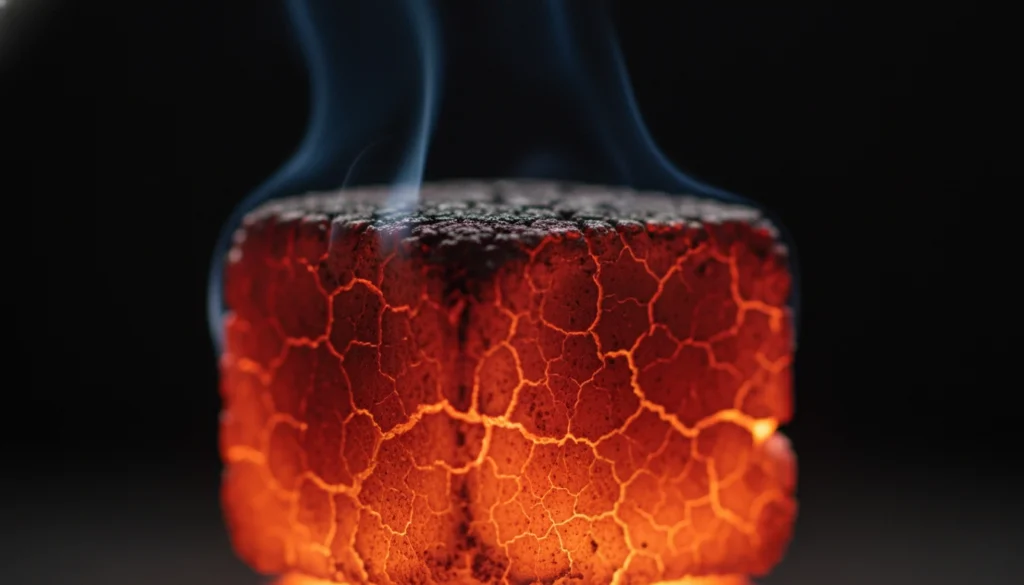
Charcoal burning test — glowing ember, stable heat output
How to Audit a Supplier — Your Pre-Purchase Checklist
Before placing a large bulk order, follow this audit checklist:
- Request recent Certificate of Analysis (CoA) — fixed carbon, ash, moisture, volatile matter, calorific value.
- Request sample bags (2–5 kg) — enough to run own tests: ignite, burn, ash, smell, density.
- Check raw material source — ensure it’s 100% mature coconut shell (no wood, palm, fillers).
- Ask for production & packaging photos or video — to verify drying, kiln, packing conditions.
- Confirm batch traceability — batch number, production date, container number (for export/import).
- Inspect packaging — sealed, moisture-proof, labelled (specs, weight, origin).
- Run real use test — grill or shisha session to see actual performance (heat, burn time, ash, smell).
If a supplier can’t meet these, move on — better to avoid risky deals.
Visual Quality Checklist — What to Inspect with Your Eyes & Hands
- Charcoal pieces are uniformly dark — no light wood color or green shell residue.
- Shape and size are consistent (for briquettes, cubes, lumps).
- Pieces feel dense and heavy, not brittle or hollow.
- Surface fracture shows clean break — dense, solid, not fibrous.
- Burned ash is light-colored (white/grey), minimal volume.
- Burn is stable, no excessive smoke, odor, or spark.
- Packaging is sealed, labelled, and dry — no condensation or damp smell.
Common Red Flags from Low-Quality Coconut Shell Charcoal
Watch out for:
- Mixed materials: raw wood, sawdust, soft shell, fillers.
- High ash (≥ 3–5%), dark ash after burning.
- Moisture > 8%.
- Irregular shape, inconsistent size/density.
- Loose, crumbly, hollow-sounding pieces.
- Strong smell, excessive smoke, popping/crackling when burning.
- No documentation, no batch traceability, or vague claims like “premium” without proof.
Buying cheap but poor-quality charcoal often leads to losses in reputation, increased waste, or customer complaints — especially in food or shisha business.